How US Companies Can Bid for UK Government Contracts
Need Help with Your Bid?
Get in touch by filling out the form and one of our advisors will be in contact.
Contact UsFor American businesses with experience delivering to federal, state or local government, the UK public sector can offer valuable opportunities to expand internationally. British contracting authorities purchase everything from technology and professional services to medical equipment, infrastructure and specialist consultancy.
However, securing a UK government contract involves more than finding a suitable request for proposal (RFP). US suppliers need to understand British procurement procedures, demonstrate that their experience meets the buyer's requirements and show how they can deliver effectively across international borders.
The good news is that US companies can compete for many UK public sector contracts without establishing a British subsidiary first. This guide explains where to find opportunities, how eligibility works and what your business needs to prepare before submitting its first UK tender.
Can US Companies Bid for UK Government Contracts?
Yes. American companies can bid for many UK government and wider public sector contracts, with established international agreements providing important market access protections.
Both the United States and United Kingdom are parties to the World Trade Organization's Agreement on Government Procurement (GPA). This creates reciprocal opportunities for qualifying businesses to compete for government contracts covered by the agreement.
Under the UK's Procurement Act 2023, qualifying overseas businesses are described as treaty state suppliers. The government's guidance on treaty state suppliers explains that these suppliers must not be discriminated against in procurements covered by the relevant international agreement.
There are important limitations. GPA protections depend on factors including the purchasing authority, the contract's subject matter and the agreement's coverage. They do not automatically apply to every public sector opportunity.
Some lower-value competitions can also be reserved for UK-based or local suppliers. For an American business, the safest approach is to check the eligibility conditions of each opportunity before committing resources to a bid.
What about the UK–US Economic Prosperity Deal?
The UK–US Economic Prosperity Deal, announced in May 2025, is relevant to the wider trading relationship, but it should not be confused with the procurement rights established through the GPA.
The deal's original general terms were not themselves a legally binding free trade agreement. American businesses should therefore avoid assuming that announcements about closer UK–US economic cooperation automatically change their eligibility for government contracts.
Our earlier article on the UK–US Economic Prosperity Deal explores its wider commercial implications. For public procurement, the existing rules and the requirements of the individual tender remain the starting point.
Where Can American Companies Find UK Government Tenders?
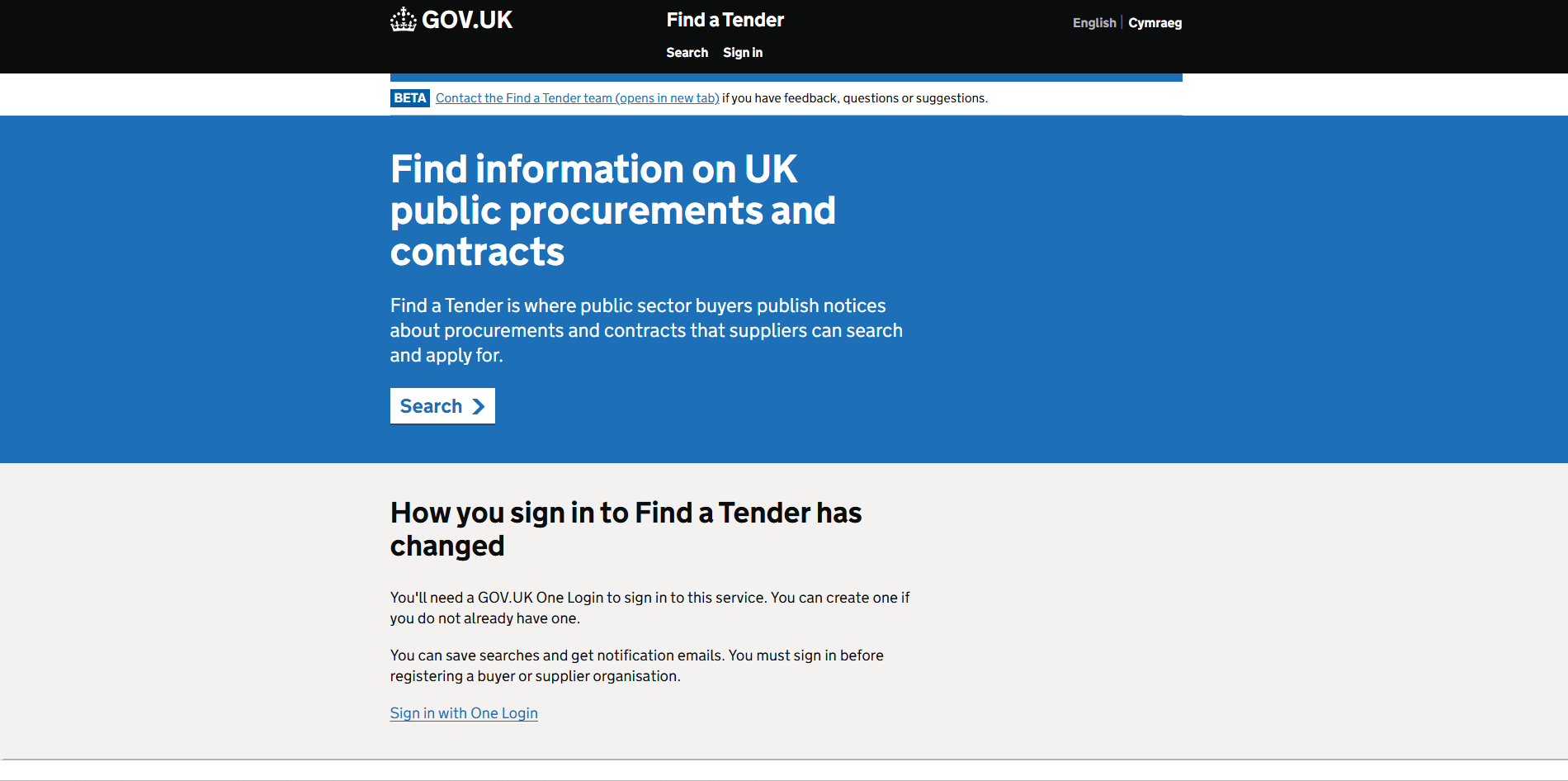
The most important platform to understand is Find a Tender, the UK's Central Digital Platform for public procurement.
Since 24 February 2025, the enhanced service has supported procurement notices, supplier registration and the sharing of core supplier information under the Procurement Act 2023.
American businesses can search Find a Tender for opportunities across different sectors, buyers and contract locations. They can also create saved searches and alerts to monitor relevant opportunities.
Other useful resources include:
- Contracts Finder: Particularly useful for searching lower-value opportunities and information about contracts in England.
- Public Contracts Scotland: A key resource for opportunities with Scottish public sector organisations.
- Sell2Wales: Provides access to procurement opportunities involving Welsh public bodies.
- Individual buyer portals: Some authorities use separate electronic tendering systems for documents, clarification questions and final submissions.
Although the Procurement Act 2023 governs much public procurement in England, Wales and Northern Ireland, devolved Scottish procurement generally operates under separate legislation. Suppliers should check which rules apply to the authority they are targeting.
Finding opportunities that suit your business
Searching for every available government contract is unlikely to produce a manageable pipeline. US companies should narrow their search around sectors where they can demonstrate credible experience and offer a competitive service.
For example, an American cybersecurity company might target UK government technology contracts, while an engineering consultancy could prioritise infrastructure frameworks or specialist advisory services.
Review procurement notices carefully for delivery locations, contract values, mandatory qualifications and submission deadlines. A large framework may appear attractive, but it is only worth pursuing if your company can meet the requirements and compete effectively.
Registering Your US Business to Bid in the UK
American suppliers participating in covered procurements under the Procurement Act 2023 should prepare to use the Central Digital Platform.
Government guidance confirms that organisations can register without a UK Companies House number. The registration process also supports non-UK addresses, meaning American companies can use their existing business details.
Registration involves creating a GOV.UK One Login, registering the supplier organisation and completing the relevant company information.
This can include:
- Legal business name, registered address and organisation identifier
- Financial records and information about economic standing
- Relevant qualifications and professional registrations
- Details of connected persons, where required
- Declarations relating to applicable exclusion grounds
The platform generates an organisation identifier and allows suppliers to maintain core information that can be shared with contracting authorities. Our guide to registering on Find a Tender explains the process in greater detail.
Remember that registration does not automatically submit a tender. Buyers may use separate portals, and each competition can require additional supporting documentation.

Do US Companies Need a UK Office or Subsidiary?
Not necessarily. There is no universal requirement to establish a UK company simply to participate in public procurement.
An American business may be able to bid through its existing legal entity, provided it meets the applicable tender requirements. Establishing a UK presence becomes a separate commercial and operational decision.
For example, a US software company could potentially deliver a cloud-based service remotely, supported by appropriate security arrangements and UK customer support. A construction contractor, meanwhile, may need personnel, equipment, subcontractors and professional registrations in Britain.
Before bidding, consider whether your proposed delivery model requires:
- UK-based employees or subcontractors
- Particular professional licences or certifications
- Insurance meeting the buyer's requirements
- Local facilities or equipment
- UK tax registration or other business arrangements
- On-site customer support and contract management
Where an overseas company establishes a physical UK business presence, separate registration and regulatory obligations may arise.
The distinction is between being permitted to bid and being fully prepared to deliver. A credible submission should explain how your organisation will meet the contract requirements, whether that involves working remotely, developing a UK operation or partnering with an established British supplier.
Can American Government Contract Experience Be Used?
US public sector experience can be valuable evidence in a UK tender, particularly where the contracts are comparable in scale, complexity or technical requirements.
A company that has delivered technology services for a federal agency, infrastructure work for a state government or specialist services for a municipal authority may already possess highly relevant capabilities.
The challenge is helping a British evaluator understand that experience.
For example, describing a project as a successful delivery for a US state agency may not tell a British evaluator enough about its complexity.
A stronger response might explain that the contract supported 25,000 users across 120 sites, maintained 99.9% service availability and achieved measurable operational improvements over three years.
That gives the buyer evidence of capability rather than simply a recognisable customer name.
The Procurement Act also places limits on certain conditions of participation, including requirements for contracts previously awarded by a particular authority and requirements for qualifications without permitting equivalents. Nevertheless, suppliers must still demonstrate that their evidence satisfies the specific procurement requirements.
Preparing a Credible UK Delivery Model
One of the biggest challenges for American suppliers is showing how services or products will be delivered reliably when the business operates across the Atlantic.
UK buyers need confidence that international delivery will not create unnecessary commercial, operational or compliance risks.
Time zones and communication
A business operating from New York may have a manageable overlap with UK working hours. A company based in California may face a greater scheduling challenge, particularly where the contract requires immediate customer support.
Explain how your service arrangements will accommodate British working hours, escalation procedures and response-time commitments.
Regulation and information security
Some contracts involve UK-specific requirements relating to information security, data protection, professional standards or sector regulation.
For example, a US technology supplier handling personal information may need to demonstrate appropriate UK data protection compliance and contractual safeguards for international data transfers.
Relevant American certifications can support your evidence, but should not automatically be presented as substitutes for mandatory UK requirements.
Mobilisation and local partnerships
A buyer may also want to understand how quickly your organisation can mobilise after award.
If local recruitment, subcontracting or specialist equipment is required, explain the proposed arrangements, responsibilities and timescales. Where partners are involved, establish how their capabilities will support delivery and how you will manage their performance.
This preparation can significantly strengthen the credibility of an overseas tender response.

Pricing UK Government Contracts From the US
American businesses should generally expect to encounter commercial schedules expressed in pounds sterling, although the tender documents determine the required pricing format.
Converting an existing USD quotation into GBP is rarely sufficient. The cost of delivering a UK contract may differ considerably from serving an American customer.
Your commercial assessment should consider:
- Exchange rates: Changes in GBP/USD rates can affect margins where revenue and costs are in different currencies.
- Tax: UK VAT treatment, corporate tax implications and other obligations depend on the transaction and business structure.
- Delivery costs: Shipping, customs duties, travel, accommodation and local logistics may affect the overall price.
- UK resources: Local employees, subcontractors and support arrangements need to be reflected in the cost model.
- Contract duration: Inflation, currency exposure and potential variations can become significant over a multi-year contract.
Check whether the authority expects prices inclusive or exclusive of VAT and whether it permits price adjustments during the contract.
A competitive bid should offer value for money while remaining commercially sustainable. Under the Procurement Act 2023, competitive awards are assessed against the published criteria to identify the most advantageous tender, rather than necessarily the cheapest submission.
How to Prepare a Competitive UK Tender Response
Once your company has identified a suitable opportunity, the next challenge is developing a submission that meets the buyer's requirements and performs well against its evaluation criteria.
There are several areas where American bidding teams should pay particular attention.
Understand British procurement terminology
A UK invitation to tender (ITT) serves a similar practical purpose to many US RFPs, but the rules and documentation are not necessarily identical.
You may encounter conditions of participation, framework agreements, dynamic markets, call-off contracts and other terminology that is less familiar to an American bid team.
Confirm what each stage requires and distinguish mandatory supplier eligibility requirements from the questions used to score the proposed solution.
Respond to the actual evaluation criteria
An impressive corporate proposal is not necessarily a competitive tender response.
UK contracting authorities commonly provide evaluation criteria, scoring methodologies and response requirements. Structure your submission around these rather than relying on generic company information or marketing material.
Use relevant examples, measurable evidence and specific commitments. Where the authority asks how a service will be delivered, explain responsibilities, processes, timescales and quality controls.
Address social value requirements
Some UK public sector tenders assess wider benefits connected to contract delivery, including employment, skills, community outcomes or environmental improvements.
American companies may have extensive corporate social responsibility initiatives, but those activities will not automatically satisfy a UK social value question.
Explain what your organisation can deliver through the particular contract and ensure that any commitments are realistic, measurable and adequately resourced.
Manage clarification questions and deadlines
If a requirement is unclear, use the formal clarification process rather than making assumptions. Questions might concern equivalent qualifications, overseas evidence, contract delivery arrangements or the treatment of particular costs.
Allow time for the authority's response and follow the stated communication procedures.
Finally, check all deadlines using the specified UK time zone. British and American daylight saving time changes occur on different dates, making deadline conversions particularly important during parts of the year.

UK Tender Readiness Checklist for US Businesses
Before committing to a UK public sector bid, confirm that your business can answer the following questions:
- Is the contract open to our business under the applicable procurement rules?
- Have we registered on the necessary supplier and tendering platforms?
- Can we provide the required financial, legal and technical information?
- Do we have relevant US or international contract examples?
- Can we meet any mandatory UK standards and regulatory requirements?
- Have we developed a realistic UK delivery and support model?
- Does our price account for currency, taxation and delivery costs?
- Can we demonstrate the quality, outcomes and wider benefits the buyer is evaluating?
- Do we have sufficient resources to prepare and submit a compliant response?
Answering these questions early helps avoid investing time in opportunities that are unsuitable or commercially unrealistic.
For businesses preparing their first submission, our article on the documents international suppliers need for UK tenders provides a useful starting point.
Frequently Asked Questions
Can a US LLC bid for a UK government contract?
Yes, a US limited liability company can potentially bid for UK government contracts through its existing legal entity. Eligibility depends on the procurement and the company's ability to meet the stated requirements. A UK subsidiary is not universally required.
Can US businesses bid without previous UK government experience?
Yes. Relevant American or international experience can demonstrate technical capability, provided it satisfies the tender's requirements. Suppliers should clearly explain the comparability of their projects and provide verifiable evidence of performance.
Are all UK government contracts open to American suppliers?
No. International procurement protections depend on the coverage of the relevant agreements, and some procurements have different or additional restrictions. Certain below-threshold opportunities can be reserved for UK-based or local suppliers. Always review the individual tender's eligibility criteria.
Start Bidding for UK Government Contracts With RFPVerse
For American suppliers, entering the UK public sector market can create opportunities to build on established capabilities and reach new customers.
Success depends on choosing suitable contracts, understanding UK procurement requirements and presenting a delivery model that gives British buyers confidence in your ability to perform.
RFPVerse helps international businesses navigate UK tenders, interpret procurement requirements and prepare clear, competitive submissions.
Whether your US company is exploring its first UK opportunity or looking to improve an established international bidding strategy, get in touch with RFPVerse to discuss how our proposal specialists can help.
Ready to start your search?
Get in touch by filling out the form to the right and one of our advisors will curate a personalised selection for you.
Get in touchBlogs. Guides. Helpful advice.
How US Companies Can Bid for UK Government Contracts

What Happens After You Win a UK Public Sector Contract? A Guide for International Suppliers