.svg)

How Canadian Companies Can Bid for UK Public Sector Contracts

Need Help with Your Bid?
Get in touch by filling out the form and one of our advisors will be in contact.
Contact UsCanadian businesses have established routes into the UK public sector market, and that relationship became even more relevant in September 2026 when CPTPP entered into force between Canada and the UK. For companies with experience delivering to Canadian federal, provincial, municipal or other public sector organisations, UK procurement can offer another substantial market for that capability.
Access alone does not make a company ready to compete. Canadian suppliers still need to understand where UK tenders are advertised, how their previous experience will be assessed, whether they need a UK presence and how differences in pricing, social value and contract delivery affect the bid. This guide covers the practical steps involved.
Can Canadian Companies Bid for UK Public Contracts?
Yes. Canadian businesses can compete for many UK public sector contracts without first becoming UK companies.
Canada and the UK already had procurement commitments through arrangements including the UK-Canada Trade Continuity Agreement and the World Trade Organization Agreement on Government Procurement. Since 1 September 2026, CPTPP has provided another framework governing trade between the two countries.
The UK government's guidance on treaty-state suppliers explains that qualifying suppliers covered by an applicable international agreement must not be discriminated against in procurements falling within that agreement. It also describes the UK as generally operating an open procurement regime.
There is an important qualification. Treaty-state status depends on the individual procurement. The relevant agreement must cover factors such as the contracting authority and the goods, services or works being purchased. A Canadian company should therefore not assume that every UK public contract is covered simply because Canada has procurement agreements with the UK.
In practice, the tender documentation remains the starting point.
What Changed With CPTPP?
The UK's accession to the Comprehensive and Progressive Agreement for Trans-Pacific Partnership did not take effect with every CPTPP member simultaneously.
Canada was the final member to ratify the UK's accession. As a result, CPTPP entered into force between Canada and the UK on 1 September 2026.
The UK government specifically identified greater access to public procurement as one of the opportunities created by the agreement becoming effective between the two countries. Its September 2026 announcement on full CPTPP access also highlighted enhanced business mobility between Canada and the UK.
That does not mean CPTPP suddenly opened a market that had previously been closed. The UK-Canada Trade Continuity Agreement has been in force since April 2021, and the government's updated guidance on trade with Canada confirms that businesses can now also use CPTPP in trade between the two countries.
For a Canadian bidder, the practical takeaway is straightforward: international agreements provide an important foundation for market access, but you still need to assess the rules and requirements of the particular procurement you want to pursue.
Where Do You Find UK Tenders?
One of the first differences Canadian suppliers need to understand is where UK opportunities are advertised.
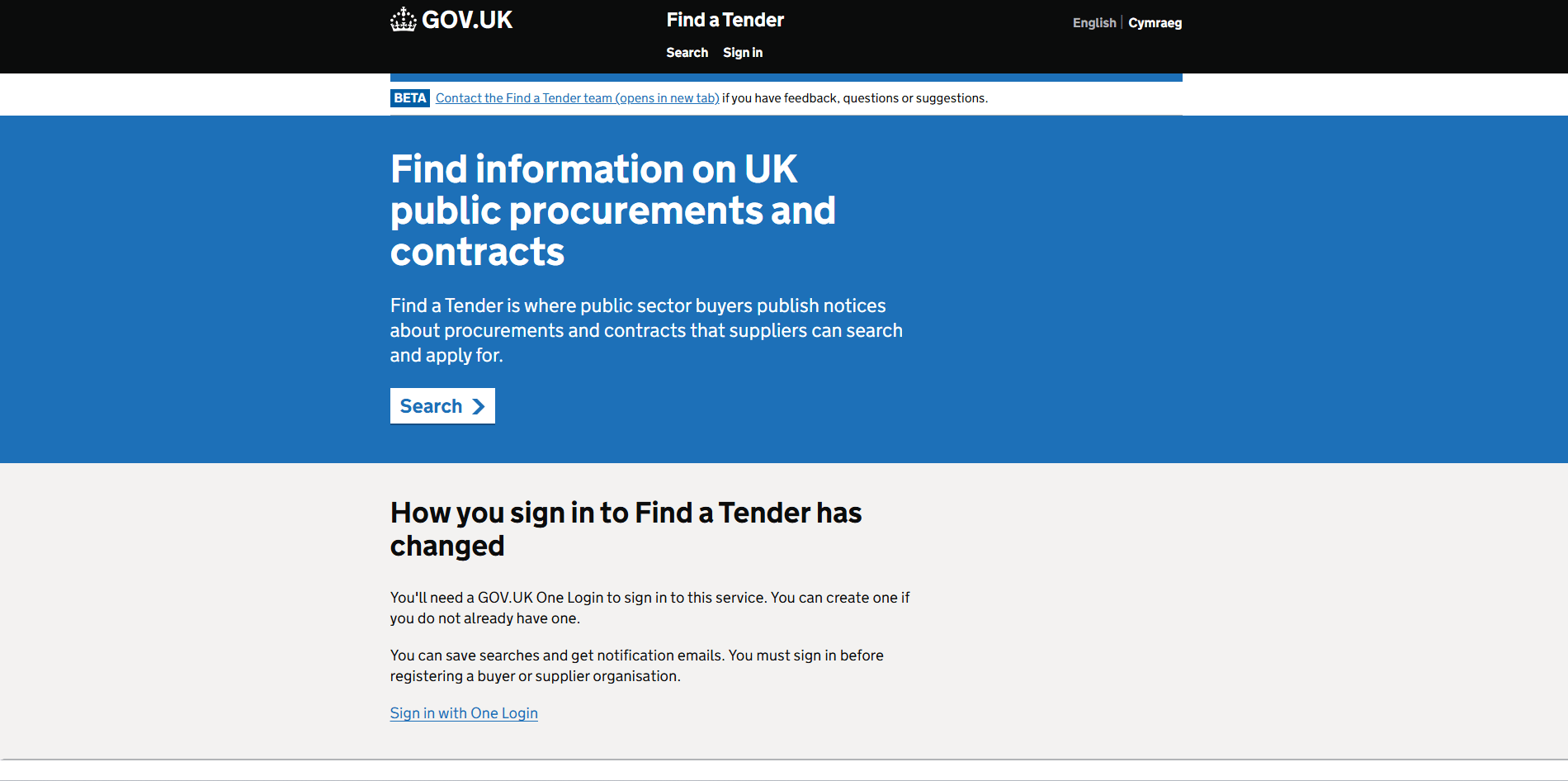
For procurements under the Procurement Act 2023, Find a Tender is the UK's Central Digital Platform. It is used to publish regulated procurement notices and enables suppliers to search for opportunities, create alerts and maintain core organisational information that can be reused across procurements. Government guidance on the Central Digital Platform explains that the enhanced service has operated since 24 February 2025. Our guide to how international businesses can register on Find a Tender covers the process in more detail.
Registration is only part of the picture. A contracting authority may advertise the notice through Find a Tender but use a separate e-sourcing portal to issue documents, manage clarifications and receive submissions. Create accounts early rather than waiting until the day you intend to submit.
Suppliers targeting Scotland should also check the procurement regime applying to the particular authority. The Procurement Act does not govern all procurement carried out by devolved Scottish authorities, so Scottish opportunities can involve different legislation and systems.
Do You Need a UK Company?
Not necessarily. There is no universal requirement for a Canadian supplier to establish a British company simply to participate in a UK public sector tender. We look at this distinction in more detail in our guide to whether international suppliers need a UK company to bid.
The more useful question is often what happens if you win. A Canadian company might be able to bid through its existing legal entity but discover that contract delivery would benefit from or require:
- UK employees
- local premises or facilities
- particular insurance arrangements
- professional registrations
- British subcontractors or delivery partners
- tax registrations
- local support capability
Separate bid eligibility from delivery readiness. You do not necessarily need to establish a UK company before pursuing an opportunity, but your bid does need a credible explanation of how the proposed contract will work in practice.
Can You Use Canadian Experience?
Canadian experience can be highly relevant to a UK tender. A supplier that has successfully delivered a complex provincial government technology contract, municipal infrastructure programme or public healthcare service should not automatically replace that evidence with a much smaller UK project simply because the latter happened in Britain.
Instead, assess which example is most comparable. The UK evaluator needs to understand what your Canadian contract proves.
Our article on whether overseas experience can count in UK tenders covers this in greater depth. The main principle is simple: do not make the evaluator work out why your Canadian experience is relevant. Explain the connection.
If a Canadian project involved 15,000 users across 80 locations and the UK authority needs a similarly distributed service, say so. If you delivered under demanding public-sector security requirements, explain how that experience informs the new contract while still acknowledging any UK-specific standards you need to meet.

Understand the UK Differences
Canadian and UK public procurement share plenty of familiar principles. Both markets emphasise competition, transparency and evidence-based supplier selection. That does not mean the systems are interchangeable.
Terminology
UK procurement uses language that Canadian suppliers may not routinely encounter. You might see terms such as:
- conditions of participation
- most advantageous tender
- framework
- open framework
- dynamic market
- social value
Do not assume that a familiar-looking phrase has exactly the same formal meaning as its Canadian counterpart.
Portals and procedures
Finding a notice on Find a Tender may only be the first step. Individual buyers can use their own procurement platforms, and the process can involve multiple notices, participation stages or further competitions.
Evidence
A Canadian policy, accreditation or case study may be entirely valid but unfamiliar to the evaluator. Explain what it demonstrates rather than simply attaching it and assuming the comparison is obvious.
The objective is not to make your Canadian business look British. It is to make your capability straightforward for a UK buyer to assess.
Build a UK Delivery Model
Eligibility and evidence will only take a bid so far. Before investing heavily in an opportunity, map out what contract delivery would actually look like. Which activities can continue from Canada? Which roles need to operate in the UK? Will your team need regular access to customer sites? Does the required support window work across Canadian and British time zones?
For example, a technology supplier might retain engineering expertise in Toronto while creating UK-based account management and service support. Another business might use a British implementation partner for on-site work while its Canadian team provides specialist technical input.
Neither model is inherently better. It needs to fit the contract.
Consider:
- People: Which roles need to be recruited locally?
- Partners: Would an established UK organisation strengthen delivery?
- Time zones: Can your support arrangements meet the required service levels?
- Mobilisation: Can people, systems and partners be ready by the required date?
- Compliance: Are UK-specific security, data, licensing or professional requirements involved?
- Travel: How frequently will Canadian employees actually need to be in Britain?
Answering those questions early also produces a more credible tender response.
Plan Social Value Early
UK social value requirements can be unfamiliar to international suppliers. A Canadian organisation may already have impressive ESG initiatives, community partnerships, graduate programmes or Indigenous procurement programmes. Those activities can demonstrate organisational capability, but they do not automatically answer a UK social value question.
The tender may instead ask what benefits will arise specifically from delivery of the new contract. For example, could you create UK jobs, develop skills, offer training or support employment pathways connected to the workforce delivering the requirement?
Our guide to social value in UK tenders explains how international suppliers can build relevant commitments.
Do not wait until the bid writer reaches the social value question. If your commitments involve recruitment, training or partnerships, they also affect mobilisation and cost.

Price for the UK Market
Canadian businesses should also resist the temptation to convert their existing CAD price into pounds and consider the job finished.
Your UK cost model could include:
- British salaries or contractors
- Canadian delivery resources
- travel and accommodation
- UK subcontractors
- insurance and compliance
- social value delivery
- mobilisation
- taxation considerations
- contingency
Currency exposure deserves particular attention. If the authority pays you in GBP while a substantial portion of your operating costs remain in CAD, exchange-rate movements can affect your margin throughout the contract.
You also need to establish how the tender treats VAT and whether pricing can change during a multi-year agreement. Our guide to pricing a UK public sector tender looks at exchange rates, VAT, inflation, payment terms and UK delivery costs in more detail.
The commercial model should reflect the service you actually promise to provide, not simply the price that looks most competitive during evaluation.
Decide Whether the Tender Is Worth Pursuing
International market entry can create pressure to pursue every seemingly suitable opportunity.
That is rarely the best use of bid resources.
Before committing, test the opportunity against a few basic questions:
- Eligibility: Can we satisfy every mandatory condition?
- Evidence: Do we have strong, comparable Canadian or international case studies?
- Delivery: Is our UK operating model credible?
- Commercials: Can we deliver at a sustainable price?
- Differentiation: Why would the buyer choose us over established UK competitors?
- Resources: Can we prepare a high-quality submission by the deadline?
A £50 million framework may sound more exciting than a £2 million contract, but the smaller opportunity could be considerably more valuable if it offers a realistic route to revenue and a stronger fit with your experience.
Understand what you are bidding for before being influenced by the headline value.
Common Mistakes to Avoid
Several avoidable mistakes can make UK market entry harder than it needs to be.
Assuming CPTPP covers everything.
International agreements matter, but coverage still needs to be considered for the particular procurement.
Using Find a Tender as the whole bidding process.
You may need to use a separate buyer portal for the actual submission.
Under-explaining Canadian evidence.
Give evaluators enough context to understand why the experience transfers.
Simply converting CAD prices into GBP.
Build the price around your proposed UK delivery model.
Sorting out delivery after the bid.
Your UK resources, partners and mobilisation assumptions should inform the tender itself.
Recycling Canadian ESG content as social value.
Answer the outcome the UK buyer is actually evaluating.
These are preparation problems rather than reasons for Canadian suppliers to avoid the market.
Frequently Asked Questions
Can Canadian Companies Bid for UK Government Contracts?
Yes. Canadian suppliers can compete for many UK government and wider public sector contracts. The exact rights and requirements depend on the particular procurement, so businesses should review the tender rather than assuming every opportunity has identical access arrangements.
Does CPTPP Mean Canadian Companies Can Bid for Every UK Tender?
No. International procurement protections depend on the coverage of the relevant agreement and procurement.
CPTPP is an important part of the UK-Canada trading relationship, but it does not remove the need to check the authority, requirement and tender conditions.
Does a Canadian Company Need a UK Subsidiary?
Not as a universal condition for participating in UK public procurement.
A UK presence may nevertheless make sense for operational, commercial or regulatory reasons depending on the contract.
Can Canadian Government Contracts Be Used as Case Studies?
Yes, where they satisfy the buyer's requirements.
Focus on relevance rather than geography. A strong Canadian public-sector contract can be persuasive evidence if you clearly demonstrate comparable scope, scale, complexity and results.
Bid for UK Contracts With RFPVerse
Canada's public sector gives businesses experience of operating in a sophisticated procurement environment, and that capability can transfer well into the UK.
The challenge is understanding how the British system works, selecting opportunities that suit your business and presenting Canadian credentials in a form that makes their relevance immediately clear.
CPTPP adds another important element to UK-Canada market access, but winning public contracts still depends on the fundamentals: eligibility, evidence, a credible delivery model, competitive pricing and a well-prepared tender.
RFPVerse helps international suppliers find suitable UK opportunities, interpret unfamiliar procurement requirements and prepare stronger public sector bids.
If your Canadian company is considering the UK public sector market, speak to RFPVerse about identifying the right opportunities and turning your existing international capability into a credible UK bid.
Ready to start your search?
Get in touch by filling out the form to the right and one of our advisors will curate a personalised selection for you.
Get in touchBlogs. Guides. Helpful advice.
How Canadian Companies Can Bid for UK Public Sector Contracts

Should You Bid? How International Suppliers Can Qualify UK Public Sector Opportunities